
5 Knives for Emergency Preparation
A good knife is a staple for your emergency preparedness kit. Here are five different types of knives you should consider having. They are presented here in a specific order: the first two are critical must-haves, and the third is pretty much an essential in a survival situation. After you obtain these, pick up the last two to make your set complete.
Throughout this article there are product links so that you can further investigate individual knives and so that I can keep this page a reasonable length. Click here for my full affiliate disclosure. Though these are available at many sporting goods stores and other outlets, Amazon consistently has the best prices and they have excellent reviews you can read. Be informed, and get what works best for you.
Swiss Army Knife
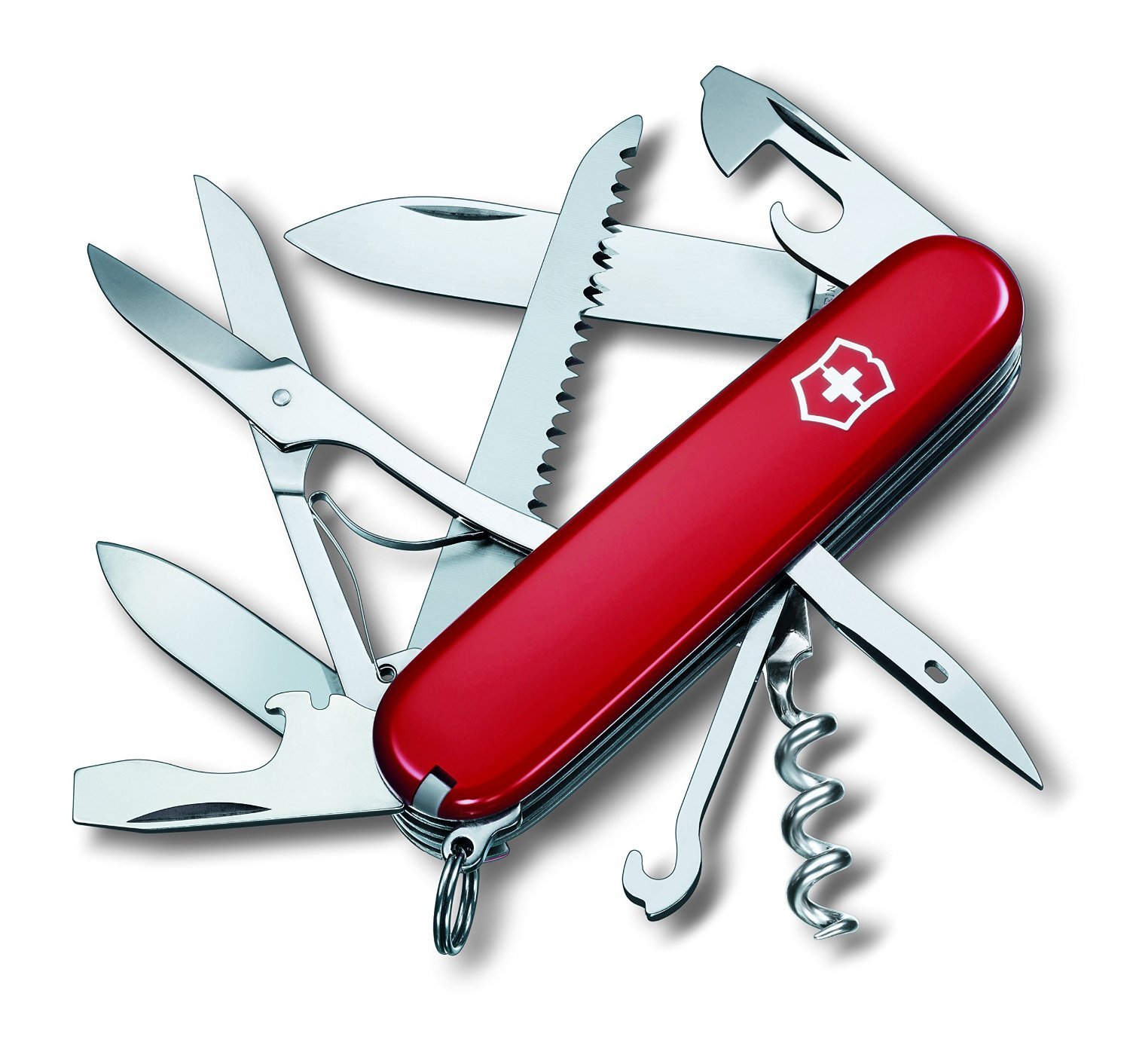 The name Swiss Army and the cross and shield logo are trademarks of Victorinox, one of the two Swiss companies that were authorized to make the knife. The second company, Wenger, was acquired by Victorinox in 2005, so now the official Swiss Army knife is from this single source. There are several other multi-tool knives on the market, as well as multi-tool devices designed around pliers.
The classic Swiss Army pocket knife has a small blade, a screwdriver with a nail file, scissors, a toothpick and tweezers. You need something bigger than that. The two most popular models of the official Swiss Army knife are the Huntsman and the Champ. The Huntsman has two blade sizes and two flat screwdrivers, a scissors, a can opener, bottle opener and corkscrew, a saw, a punch, hook, awl and wire stripper along with the toothpick and tweezers. The Champ goes all out by adding pliers, a metal saw, Philips screwdriver, a fish scaler, rulers, and even a small magnifying glass and ball point pen. There is even a separate very small screwdriver that threads into the corkscrew for tightening your eyeglasses or other very tiny slotted screws.
Victorinox also makes a pliers based multi-tool with the Swiss Army brand name Spirit with more of an emphasis on the heavier pliers. You may also want to consider similar products by Leatherman, another established high quality manufacturer. If you go this route for your emergency kit, you will want to make sure you have met your pocket knife requirements with a good stand-alone folding knife.
Single Blade Folding Knife
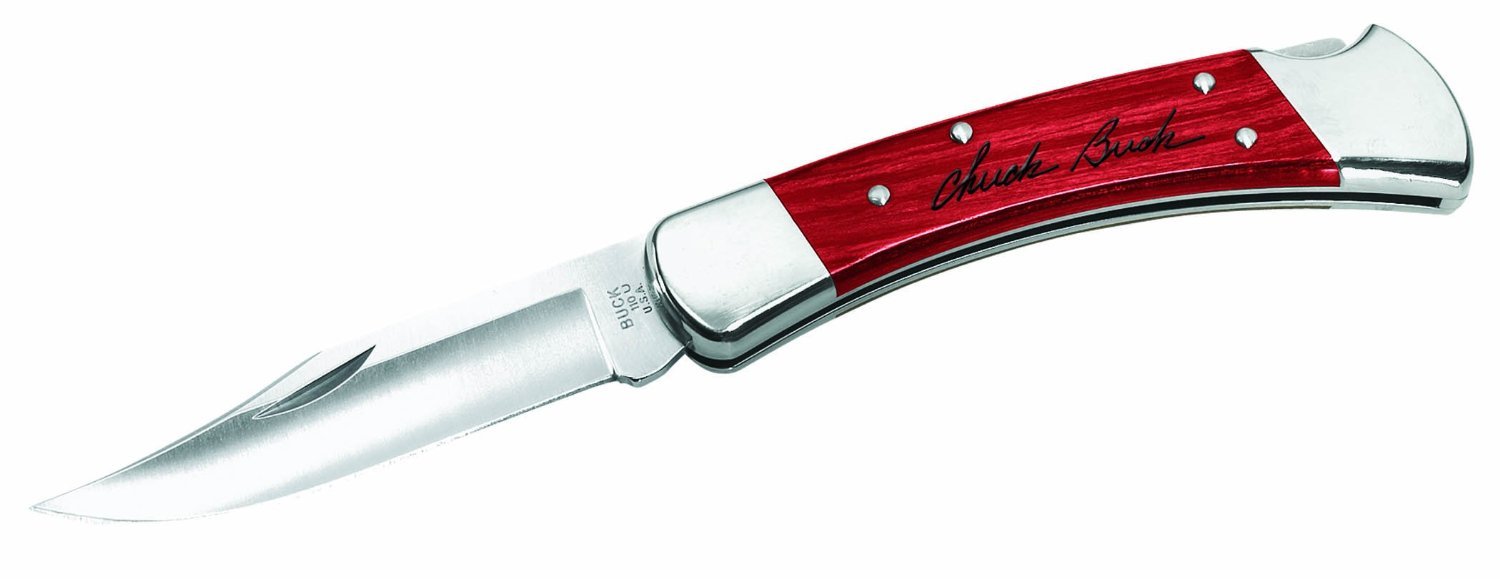 This is your primary emergency pocket knife, so don’t skimp on this one. Choose a reputable manufacturer and read what others have to say about it before you decide which one is best for you. These come in various shapes and sizes, but their central theme is a rugged design and simplicity of use. Unlike multi-blade pocket knives, whether simple two- or three-blade designs or the elaborate Swiss Army knife, single blade folding knives focus on a compact design and one larger hard-working blade.
You will want a durable and comfortable handle and a good locking mechanism for safety to keep the blade from folding back during use. The locking blade release might be in the middle or at the end of the back, or right at the folding point of the blade. Look for a blade around 3-1/2 to 4 inches long with a non-serrated edge (go for the partially serrated blade in your survival knife).
The Buck 110 Hunter is probably the most popular high-end folding knife. With a high carbon steel blade and a crescent-shaped point, it has several options for the handle. This knife is made in the USA. Ontario Knife Company, maker of Old Hickory cutlery, has very high rated folding knives that are just a little less expensive. These are also made in the USA. I don’t personally own an Ontario folding knife, so if you do please leave a comment and let us know what you think.
Survival Knife
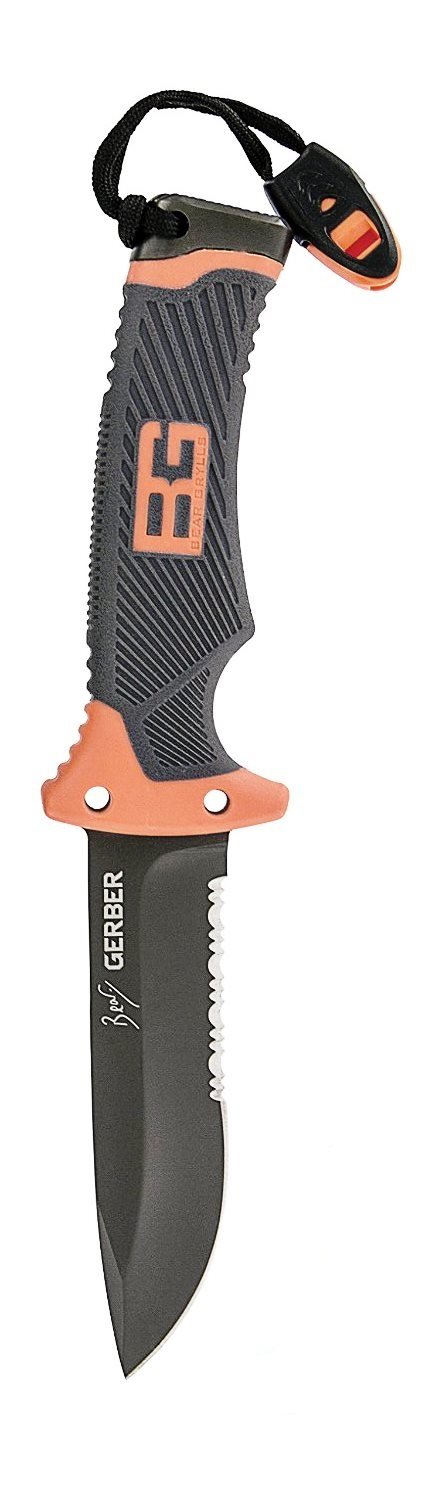 Your survival knife is a larger fixed-blade multi-purpose knife. It should have a 5- to 7-inch partially serrated blade with a sharp point. This knife is designed to cut light sticks and brush, skin a small animal, dig into a river bank or around plant roots or rip through rope or heavy fabric. You want a workhorse knife that you are not afraid to abuse and eventually replace, not one that costs you a fortune and you are hesitant to use.
There are many options, but I am only going to recommend one: the Bear Grylls Ultimate Survival Knife from Gerber. This has a 4.75-inch half-serrated high carbon stainless steel blade and a rubber grip handle. The base of the handle has a stainless steel hammer and a place to attach the lanyard, which has an emergency whistle. The sheath has an integrated sharpener and a fire-starter rod. That is a lot of extras besides the knife itself, but that is what the “survival knife” is all about.
There are other options, including some that have hollow handles for other survival items like this one from Harbor Freight. Be careful that you don’t buy a novelty item instead of something you can actually use. Opting for the lowest priced item is probably a waste of money.
Store this knife in your go bag, but take it out and use it regularly. Carry it with you when you go camping, hunting or fishing. It is even a Biblical mandate to have something with you to dig a hole when you relieve yourself in the wild (Deuteronomy 23:13). Carry it, use it, sharpen it, and if you mess it up, just replace it.
Once you have these three basic knives in your kit (Swiss Army knife or multi-tool, single-blade folding knife and survival knife), there are two more you should consider adding.
Machete
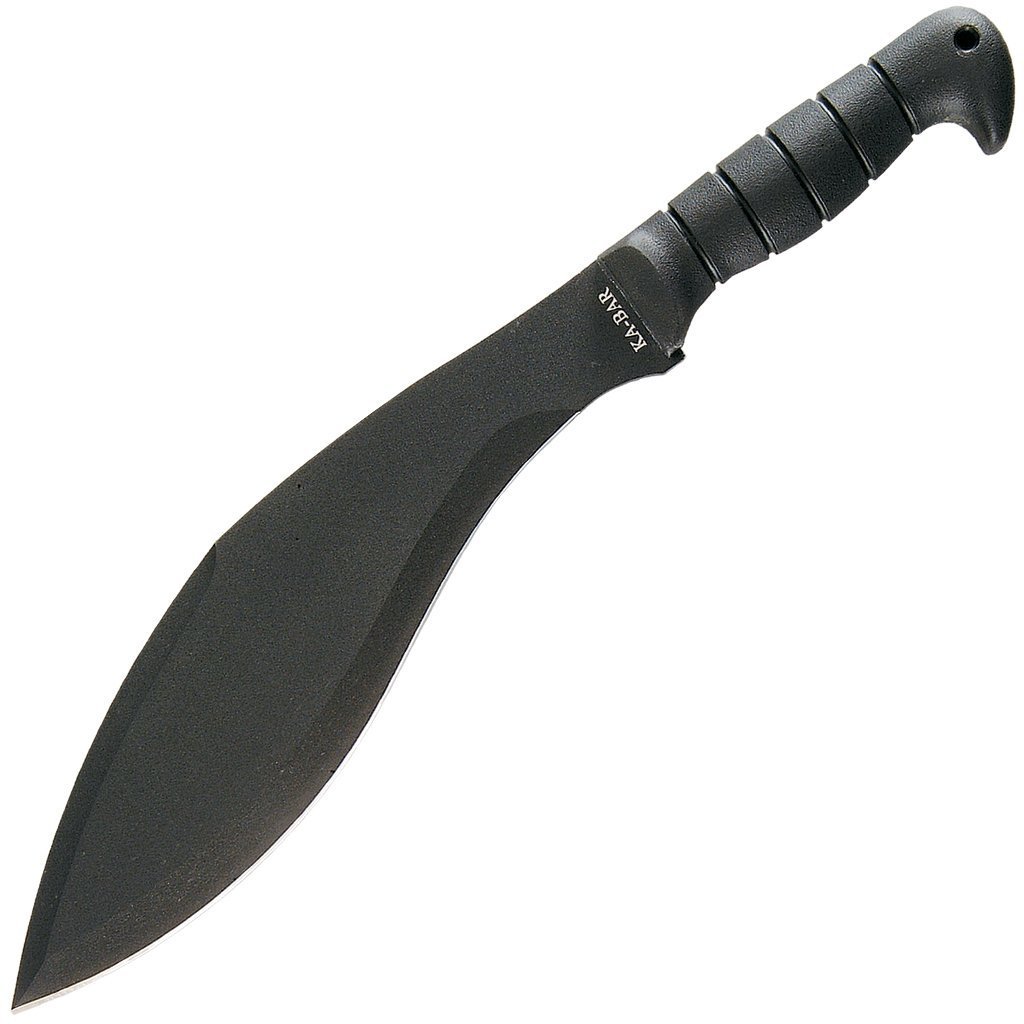 Your machete is designed to cut through heavy brush, and can also be used to chop, slaughter game, bust through doors or other heavy-duty work. It could also be a weapon. This is a large knife, with a blade usually 12- to 20-inches long. Larger knives will be too difficult to handle.
There are several different shapes, and if possible you should hold them to see how they are balanced in order to select the kind you want. I have an old straight one with wooden handles and no markings and about a 16-inch blade. I also have a Ka-Bar machete that I really like, a Kukri style with a 12-inch blade made in the USA. This blade is wider at the end, making it feel more like a hatchet, and the end is pointed so that it can pierce – it is actually designed for combat. The leather-sheaved knife fits easily down the side of my large backpack.
Take your machete out and clear away some tall weeds or brush next time you are camping. Don’t do that in a national or state park where the natural habitat for wildlife is protected. Be sure you clean the blade well when you are finished.
Marine Corps Combat Knife
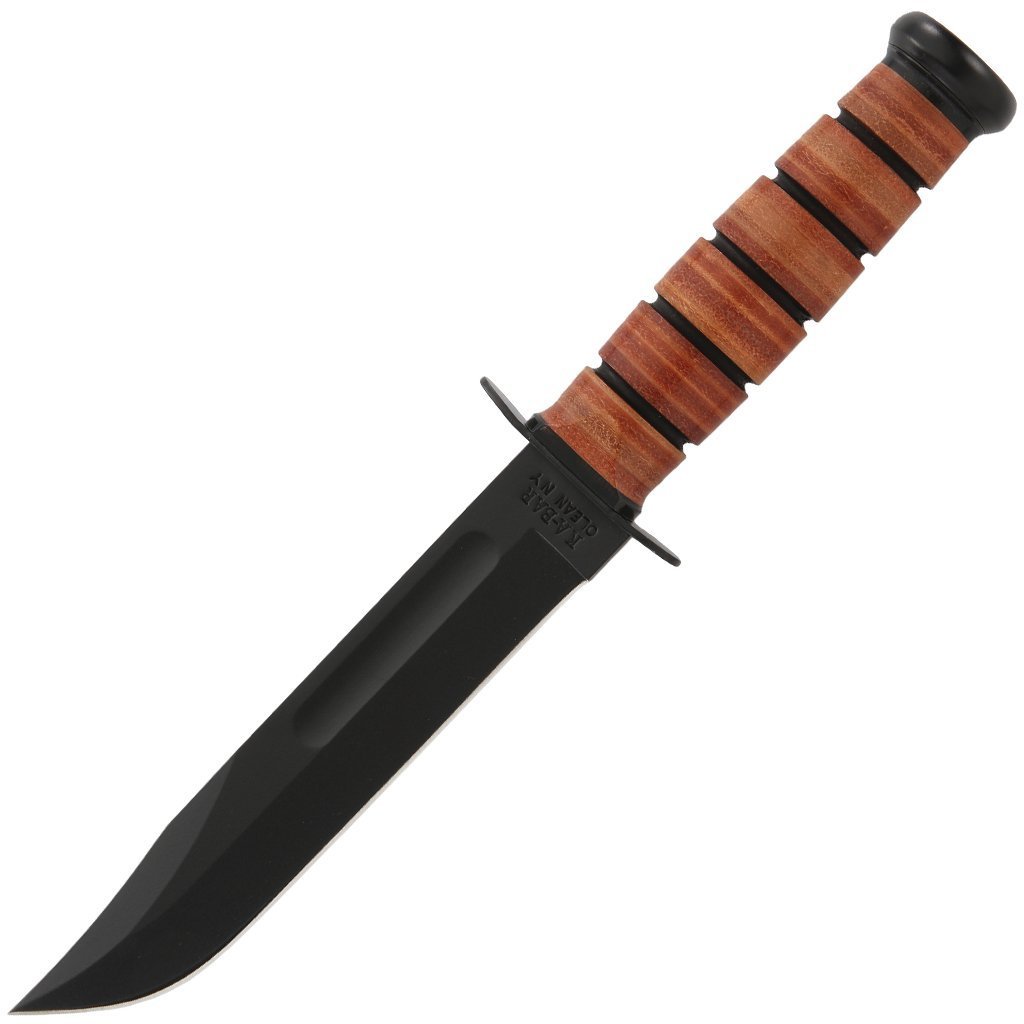 This American-made knife is one of the most well known throughout the world. Made by Ka-Bar for WWII troops, the Full Size US Marine Corps Fighting Knife was designed for combat. I bought mine more than five years ago and have never found myself in a combat situation. If I did, I think I would prefer 9mm of lead to this 7-inch 1095 chrome vanadium steel blade, but hey, it is a cool knife. This is larger than your survival knife, and you will still use your Bear Grylls knife from Gerber for everyday purposes.
It features a razor sharp blade, leather handle and strategically designed balance for efficient handling. The point is very sharp, made to pierce and then cut. The one I am recommending is the original style, and it also is available with a partially serrated edge or in a smaller design with a 5-inch blade. One version is offered with a Kraton (synthetic rubber) handle for an all-black appearance without the USMC designation. There is an Army and Navy version as well, the only difference is the stamping. You can even get this knife as a presentation piece with a gold-plated brass guard and pummel (end cap).
A good knife is essential to your go bag and emergency preparation. If you have experiences with these knives, or have another you would recommend, please feel free to leave a comment below.
I can still remember the first time my grandfather gave my a knife. We are big fishermen and my grandfather told me I will always find a use for my Swiss Army Knife. I still have that knife and have since bought many more. It’s definitely a must have knife. I love the outdoors and might have to have a look into getting a survival knife.
Really nice post and found out just what I needed to.
Wonderful memories, I love to hear those stories. Thanks for sharing. Glad I could provide helpful information and happy shopping for the survival knife – I still think the Bear Grylls knife is a great deal.
Having lived in the country all my life, i’ve carried a knife pretty much since i was a kid. One thing that always bothered me was that bulge in my pocket from the pocket knife. I finally found the solution. I now carry a leatherman with a pocket clip, so the leatherman is inside my pocket and the clip is onthe outside. Works like a charm and i couldn’t live without my leatherman.
Great comment and thanks for the suggestion. Many years ago I used to carry a pager the same way – clip on the outside with the pager inside at the top of my pocket. This is a perfect way to carry what you need without the pocket bulge. Thanks again!
I’ve never carried or owned a knife, the only weapon I own is a Taser! But this is interesting content for anyone that does need or have interest in owning a knife! I have fond memories as a child of my father coming to the rescue whenever we needed something cut quickly (ie. mostly tags off of our clothes after a shopping-spree!!!) using his Swiss Army Knife. My husband own’s a really nice Leatherman, but reading this article makes me want to get him a Swiss Army Knife too 🙂