
Easy Food Storage
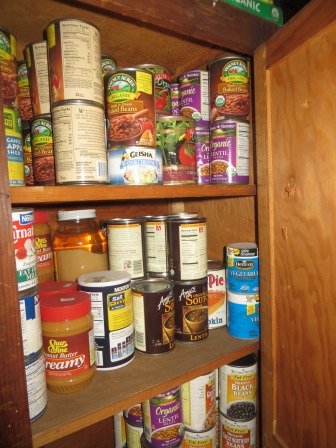 How much food should you have on hand? It has been estimated that the average American family has little more than a one week supply of food on hand, however it is not the proper mix of food products to sustain a family for a full week. We have become accustomed to going to the local store and buying only what we need (or rather, want) when we want it. This is a much different practice than our great grandparents, who probably made a stock-up shopping trip once a week, or every two weeks, or even once a month.
If you are reading this, you have probably already decided that you need to prepare for the possibility of a disaster in the future. Food will be an important part of that preparation. How much do you need, and how do you get started if funds are limited?
If you have never considered emergency food storage before, start with a simple goal of one month’s supply. You can build on this after you have met the initial goal. However, if you begin by planning for, say, a one year stash of emergency food without just making one bulk purchase, chances are your pantry will be very lopsided, with large quantities of some things and minimal or no stock of other needed items.
Plan that during the next three months you will pick up a few extra items when you make your regular grocery shopping trip. Begin by stocking up on dry or canned goods, such as canned vegetables, soups, tuna or salmon, and the like. You might pick up some extra pasta, oatmeal, packaged potato side dishes and nuts. Buy things that you would normally eat anyway. If you find them on sale, buy extra.
Remember that some of the things you buy require additional ingredients to prepare them. Your potato sides, for instance, may require butter (or margarine) and maybe milk. You may need salt or sugar, things that you ordinarily would have in your cupboard. Buy one extra package of each, and when you begin to use that “extra” package, replace it.
If you are buying extra regular grocery store items that you would normally buy, you will want to rotate them as you use them. Store them by the “best by” dates on the packages, but don’t be too concerned about what that date is. These dates are not regulated by the FDA, but rather by the manufacturers who use them for inventory purposes. In almost all cases, food is good far beyond the “best by” date on the package. It has been estimated that Americans throw out as much as 40% of the food they buy, around $165 billion of good, edible food annually. Learn how to look at a can, jar or box and judge whether or not the contents are good. A can of vegetables that is not rusty or dented, has undamaged seams and no signs of bulging probably has at least a 5-year shelf life, maybe longer. If you buy what you normally use anyway and rotate it as you use it, you will never have a problem with dates.
In the same way that consumers are buying food items as the need them, so the grocery stores have moved to a “just in time” inventory management system. The average neighborhood grocery store has an annual inventory turn of 14 to 15 times. Of course, some items have a much higher turn rate, and other items are lower. This means, though, that on average there is about a 3 to 4 week supply of food for a typical volume of customers inside the store. If there would be some natural or man-made disaster, shelves will clear much faster than 3 weeks. And if this disaster somehow curtails deliveries, these shelves will not be restocked soon.
Comments
Easy Food Storage — No Comments
HTML tags allowed in your comment: <a href="" title=""> <abbr title=""> <acronym title=""> <b> <blockquote cite=""> <cite> <code> <del datetime=""> <em> <i> <q cite=""> <s> <strike> <strong>